That new header image is of Ida and Dactyl, an asteroid with its very own tiny moon. I've always loved the photo. Reminds me of a parent and child, bonded by gravity, rotating around a common center. Plus, I didn't know asteroids could have moons.
A coupla cool comments about the photo in my last post (see below). Margaret said it looked like a stellar semi-colon. Laurita said her kid told her it looked like the moon was hanging by a thumbtack. Nice. I will never look at the Venus-moon pas de deux quite the same way again.
Woke up at 4 a.m. yesterday to drive out just east of town and look for Comet McNaught. Didn't find it. It was oddly enjoyable still; I parked on a country road and cracked open a beer and scanned the sky right around Perseus with binoculars til the beer was gone. Went home, went back to bed. I'll look for it next month, after it's passed around the sun and is heading back out to its home in the Oort Cloud.
The Mets have won 6 games straight. A half a game outta first place. Of course, this weekend we play the Evil Empire (the Yankees, for you uninitiated), so anything could happen. We're also going to see a AAA ballgame on Sunday to celebrate Father's Day. Free gloves to the first 1500 kids! And we get to have a catch on the field before the game. Big Fun. Hot dogs will be involved.

Showing posts with label Oort Cloud. Show all posts
Showing posts with label Oort Cloud. Show all posts
Thursday, June 17, 2010


Thursday, May 20, 2010
Comet McNaught
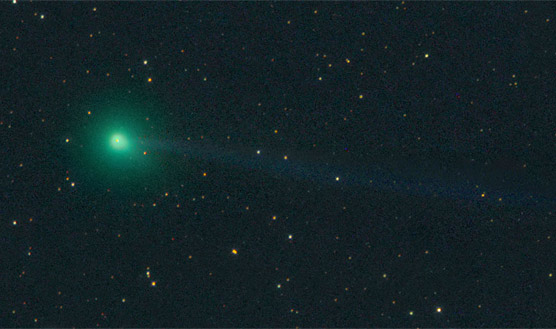
There is a brand new comet in the dawn sky, one that'll max out in brightness next month. You'll probably still need binoculars or a telescope to see it, but still. Comets make me giddy (admittedly I am easily made giddy). They are leftover bits from the beginnings of the solar system, chock full of water and amino acids and at least partly responsible for bringing those things, and possibly life itself, to Earth. Plus, they come from...wait for it...the Oort Cloud! The Oort Cloud is a largely theoretical sphere of ice and rock chunks at the very fringes of the solar system, about a light year away. The comets lurk out there in cold storage, slowly revolving, unseen, until something tugs them out of orbit and sends them hurtling toward the sun. As they get close to the sun they form tails, as solar wind boils off ice from the main body of the thing.
This one is on its first trip in from the Oort Cloud, so no one knows quite what will happen. Comets are notoriously unpredictable. They might fizzle out, they might soar in brightness, they might disintegrate as they swing around the sun and gravitational stress rips them apart. Stay tuned. This one is already slightly brighter than predicted.
Below is a chart telling you where to look in the dawn sky (I'm never up at dawn, but will set my alarm one or two mornings mid-month to look for it). The star Capella is very bright, so using it as a guide will help. Comets are fairly easy to pick out from the surrounding stars. They have fuzzy, indistinct edges, unlike the pinpoints of light formed by stars. They are dimmer, larger than stars. Sometimes you can even make out the tail. So get up early, get out your binoculars and search the sky. Even if you don't find the comet,you'll probably find something cool. There's lotsa cool stuff up there.

Wednesday, August 12, 2009
More Saturnian Weirdness
Something big and weird punched through Saturn's F-ring recently. Here's a picture.

 To help you make sense of the image: the thing was approaching from below the ring, blasted through the ring and left a plume of material pointing toward the upper right hand corner of the picture, the plume is casting a shadow toward the lower lefthand corner.
No one knows what it is. Other than a great big space rock, probably.
I learned about it by listening to Phil Platt, of Bad Astronomy, on Coast to Coast last night (I got the pix from his site as well). For those of you not in the know, Coast to Coast is the gloriously strange radio show devoted to alien abductions, the Hollow Earth theory, the Taos Hum, Bigfoot, etc. It's about 80% silly, 20% interesting.
This is from the 20% interesting bit.
It comes on the heels of the comet slamming into Jupiter last month. Do I sense a pattern here? Did some passing object perturb the orbits of all those frozen space rocks at the edge of the Solar System? Are we about to be bombarded with shrapnel from the Oort Cloud?
Stay tuned.

 To help you make sense of the image: the thing was approaching from below the ring, blasted through the ring and left a plume of material pointing toward the upper right hand corner of the picture, the plume is casting a shadow toward the lower lefthand corner.
 No one knows what it is. Other than a great big space rock, probably.
I learned about it by listening to Phil Platt, of Bad Astronomy, on Coast to Coast last night (I got the pix from his site as well). For those of you not in the know, Coast to Coast is the gloriously strange radio show devoted to alien abductions, the Hollow Earth theory, the Taos Hum, Bigfoot, etc. It's about 80% silly, 20% interesting.
This is from the 20% interesting bit.
It comes on the heels of the comet slamming into Jupiter last month. Do I sense a pattern here? Did some passing object perturb the orbits of all those frozen space rocks at the edge of the Solar System? Are we about to be bombarded with shrapnel from the Oort Cloud?
Stay tuned.
Wednesday, February 25, 2009
Church
A tough few weeks. My parents' health problems are slowly beginning to rear their heads. The dogs of mortality nipping at my heels.
So.
Went out with the big, dumb telescope and a few cans of beer in a cooler to see Comet Lulin last night, as it passed as close to the Earth as it's ever gonna get. Frankly, there's not much to get too excited about, visually. It's a big, green, fuzzy blob, with no real detail (neither of it's two tails visible, for instance).
The fun comes in when you imagine what's happening out there, send your mind out there to hang out with the comet awhile. The thing is leaving debris of rock and ice in one direction, and ionized gas is being boiled off by the sun in the other direction (thus the two tails). It is going impossibly fast, on it's way out of our neighborhood and back into the far cold of...wait for it...the Oort Cloud.
It will return in 5 million years.
That's a big orbit.
Huge forces at work in empty spaces, seen from impossible distances.
A feeling quite similar to being in church. Back when I was a kid, and went to church. And had those kind of feelings about church. Of course, in a church, you aren't allowed to bring beer. So that's a plus.
It was a clear night, and warm. Other stuff was out in the sky as well. Spent quite a bit of time on Saturn, as it was close to the comet. What a pretty sight. The Orion Nebula was in full glory - I've never seen it in this much detail before. Looked for, but did not find, the Horsehead Nebula. Found the Andromeda Galaxy, big and bright but as it was low in the sky and guttering in the remnants of the city glare, no real detail. Still, it is a jewel in the sky.
Here's a picture of the comet from NASA's Pic of the Day. I didn't take it. But it shows the two tails in all their glory. Lulin will be bright for a few more days. Go out and look for it. Send your mind out there for awhile. Imagine you're in church.

So.
Went out with the big, dumb telescope and a few cans of beer in a cooler to see Comet Lulin last night, as it passed as close to the Earth as it's ever gonna get. Frankly, there's not much to get too excited about, visually. It's a big, green, fuzzy blob, with no real detail (neither of it's two tails visible, for instance).
The fun comes in when you imagine what's happening out there, send your mind out there to hang out with the comet awhile. The thing is leaving debris of rock and ice in one direction, and ionized gas is being boiled off by the sun in the other direction (thus the two tails). It is going impossibly fast, on it's way out of our neighborhood and back into the far cold of...wait for it...the Oort Cloud.
It will return in 5 million years.
That's a big orbit.
Huge forces at work in empty spaces, seen from impossible distances.
A feeling quite similar to being in church. Back when I was a kid, and went to church. And had those kind of feelings about church. Of course, in a church, you aren't allowed to bring beer. So that's a plus.
It was a clear night, and warm. Other stuff was out in the sky as well. Spent quite a bit of time on Saturn, as it was close to the comet. What a pretty sight. The Orion Nebula was in full glory - I've never seen it in this much detail before. Looked for, but did not find, the Horsehead Nebula. Found the Andromeda Galaxy, big and bright but as it was low in the sky and guttering in the remnants of the city glare, no real detail. Still, it is a jewel in the sky.
Here's a picture of the comet from NASA's Pic of the Day. I didn't take it. But it shows the two tails in all their glory. Lulin will be bright for a few more days. Go out and look for it. Send your mind out there for awhile. Imagine you're in church.

Thursday, May 8, 2008
A God of Ice and Rock
One of the cooler things about the Oort Cloud is that it may not even exist.
It is purely theoretical, and has never been directly observed. The reason for its theoretical existence is because it explains the behavior of comets. Comets seemingly come out of nowhere, and while most of the rest of the solar system stays within the plane of the solar system (except for that contrarian former planet Pluto and the odd asteroid here and there), comets come barreling in at all possible angles.
So there's that.
Also, if comets were simply orbiting elements of the solar system, zooming toward the sun every few hundred years or so, there wouldn't be any more comets. The solar system has been around a very long time, and comet orbits are by nature pretty unstable; after this long a time most comets should have collided with a planet or the sun, or been flung out of the solar system by gravity, or simply broken apart by close passes to the sun.
And the Oort Cloud explains that pretty well too.

Here's the theory: there is a great cloud of icy rocks surrounding the solar system in a sphere (as opposed to a disc), rocks left over from the birth of the solar system. The outer edge of the cloud is VERY far away, around a light year (the closest star, by comparison, is about 4 light years away). Since these iceballs are so far away, they are only tenuously connected by gravity to the sun, and thus are easily pulled out of orbit by passing stars, passing black holes, the plane of the galaxy, etc.. When something passes by, it affects the orbits of what it encounters. If that something is large enough, and passes close enough, everything in the Oort Cloud goes a little nutty. Orbits near the cosmic interloper change, and there is a cascade effect where objects with changed orbits change the orbits of other objects, which in turn affect other orbits, which in turn affect other orbits, on and on.
The result is the the solar system gets pelted with iceballs, like pellets shot out of a shotgun. Which helps explain all those craters on the various moons and planets out there. And helps explain as well why there is a mass extinction event here on Earth every several million years (tangentially related is the idea that every time we pass through the plane of the galaxy, roughly every 32 million years, the Oort Cloud gets jostled and everything dies; the fossil evidence bears this out).
It's also an explanation for those uncommonly beautiful objects occasionally gracing our skies, improbable tails arching across the sky like a bridge to a foreign land.

Comets might even explain the existence of life itself. They contain a lot of water, and are widely theorized to contain the amino acids responsible for life as well. So comets may have brought life came to Earth, and perhaps others places as well.
So. Let's recap. It might or might not exist. It had been around since the beginning of the world. It explains the physical world around us. It graces us with uncommon beauty. It is responsible for mass extinctions, and perhaps for the origin of life as well.
Might exist, might not. Timeless and beautiful. Responsible for the life and death of worlds.
Remind you of anyone?
It is purely theoretical, and has never been directly observed. The reason for its theoretical existence is because it explains the behavior of comets. Comets seemingly come out of nowhere, and while most of the rest of the solar system stays within the plane of the solar system (except for that contrarian former planet Pluto and the odd asteroid here and there), comets come barreling in at all possible angles.
So there's that.
Also, if comets were simply orbiting elements of the solar system, zooming toward the sun every few hundred years or so, there wouldn't be any more comets. The solar system has been around a very long time, and comet orbits are by nature pretty unstable; after this long a time most comets should have collided with a planet or the sun, or been flung out of the solar system by gravity, or simply broken apart by close passes to the sun.
And the Oort Cloud explains that pretty well too.

Here's the theory: there is a great cloud of icy rocks surrounding the solar system in a sphere (as opposed to a disc), rocks left over from the birth of the solar system. The outer edge of the cloud is VERY far away, around a light year (the closest star, by comparison, is about 4 light years away). Since these iceballs are so far away, they are only tenuously connected by gravity to the sun, and thus are easily pulled out of orbit by passing stars, passing black holes, the plane of the galaxy, etc.. When something passes by, it affects the orbits of what it encounters. If that something is large enough, and passes close enough, everything in the Oort Cloud goes a little nutty. Orbits near the cosmic interloper change, and there is a cascade effect where objects with changed orbits change the orbits of other objects, which in turn affect other orbits, which in turn affect other orbits, on and on.
The result is the the solar system gets pelted with iceballs, like pellets shot out of a shotgun. Which helps explain all those craters on the various moons and planets out there. And helps explain as well why there is a mass extinction event here on Earth every several million years (tangentially related is the idea that every time we pass through the plane of the galaxy, roughly every 32 million years, the Oort Cloud gets jostled and everything dies; the fossil evidence bears this out).
It's also an explanation for those uncommonly beautiful objects occasionally gracing our skies, improbable tails arching across the sky like a bridge to a foreign land.

Comets might even explain the existence of life itself. They contain a lot of water, and are widely theorized to contain the amino acids responsible for life as well. So comets may have brought life came to Earth, and perhaps others places as well.
So. Let's recap. It might or might not exist. It had been around since the beginning of the world. It explains the physical world around us. It graces us with uncommon beauty. It is responsible for mass extinctions, and perhaps for the origin of life as well.
Might exist, might not. Timeless and beautiful. Responsible for the life and death of worlds.
Remind you of anyone?
Subscribe to:
Posts (Atom)