That new header image is of Ida and Dactyl, an asteroid with its very own tiny moon. I've always loved the photo. Reminds me of a parent and child, bonded by gravity, rotating around a common center. Plus, I didn't know asteroids could have moons.
A coupla cool comments about the photo in my last post (see below). Margaret said it looked like a stellar semi-colon. Laurita said her kid told her it looked like the moon was hanging by a thumbtack. Nice. I will never look at the Venus-moon pas de deux quite the same way again.
Woke up at 4 a.m. yesterday to drive out just east of town and look for Comet McNaught. Didn't find it. It was oddly enjoyable still; I parked on a country road and cracked open a beer and scanned the sky right around Perseus with binoculars til the beer was gone. Went home, went back to bed. I'll look for it next month, after it's passed around the sun and is heading back out to its home in the Oort Cloud.
The Mets have won 6 games straight. A half a game outta first place. Of course, this weekend we play the Evil Empire (the Yankees, for you uninitiated), so anything could happen. We're also going to see a AAA ballgame on Sunday to celebrate Father's Day. Free gloves to the first 1500 kids! And we get to have a catch on the field before the game. Big Fun. Hot dogs will be involved.

Showing posts with label comets. Show all posts
Showing posts with label comets. Show all posts
Thursday, June 17, 2010


Thursday, May 20, 2010
Comet McNaught
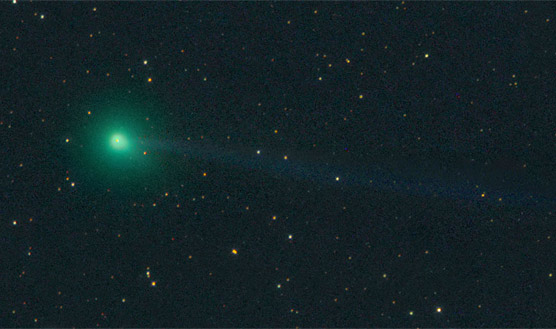
There is a brand new comet in the dawn sky, one that'll max out in brightness next month. You'll probably still need binoculars or a telescope to see it, but still. Comets make me giddy (admittedly I am easily made giddy). They are leftover bits from the beginnings of the solar system, chock full of water and amino acids and at least partly responsible for bringing those things, and possibly life itself, to Earth. Plus, they come from...wait for it...the Oort Cloud! The Oort Cloud is a largely theoretical sphere of ice and rock chunks at the very fringes of the solar system, about a light year away. The comets lurk out there in cold storage, slowly revolving, unseen, until something tugs them out of orbit and sends them hurtling toward the sun. As they get close to the sun they form tails, as solar wind boils off ice from the main body of the thing.
This one is on its first trip in from the Oort Cloud, so no one knows quite what will happen. Comets are notoriously unpredictable. They might fizzle out, they might soar in brightness, they might disintegrate as they swing around the sun and gravitational stress rips them apart. Stay tuned. This one is already slightly brighter than predicted.
Below is a chart telling you where to look in the dawn sky (I'm never up at dawn, but will set my alarm one or two mornings mid-month to look for it). The star Capella is very bright, so using it as a guide will help. Comets are fairly easy to pick out from the surrounding stars. They have fuzzy, indistinct edges, unlike the pinpoints of light formed by stars. They are dimmer, larger than stars. Sometimes you can even make out the tail. So get up early, get out your binoculars and search the sky. Even if you don't find the comet,you'll probably find something cool. There's lotsa cool stuff up there.

Tuesday, October 6, 2009
Mama Comet
Comets, it turns out, can have babies.
Just before I started this blog I got to see one of my favorite comets ever - Comet Holmes - in the December sky. It was supposed to be a ho-hum not very bright comet, invisible to the naked eye, but suddenly exploded in brightness, becoming a million times brighter in less than a day, surprising everyone. It became easy to see, even through the glare of light from a small town. I watched it from my backyard for several nights running.
What happened was, Holmes spawned a bunch of mini-comets, rushing away from it at 280 mph, some of them big enough to have their own tails. No one has ever seen this happen before. Even though Comet Holmes was/is only a coupla miles wide, the sphere of dust and ice ejected was bigger than the sun. You can see the sphere of material pretty clearly in the picture. This is actually what it looked like through binoculars. Not as detailed, of course, but you could see the bright center and the less dense cloud surrounding it.

There is a theory that comets brought water and amino acids to Earth, thus providing it with the building blocks for life. So those baby comets may go on to create babies of an entirely different kind one day, on a planet, a moon.
The comet remained intact, and is returning in 2014, six years later. I'll be looking forward to seeing what happens this next time.
Just before I started this blog I got to see one of my favorite comets ever - Comet Holmes - in the December sky. It was supposed to be a ho-hum not very bright comet, invisible to the naked eye, but suddenly exploded in brightness, becoming a million times brighter in less than a day, surprising everyone. It became easy to see, even through the glare of light from a small town. I watched it from my backyard for several nights running.
What happened was, Holmes spawned a bunch of mini-comets, rushing away from it at 280 mph, some of them big enough to have their own tails. No one has ever seen this happen before. Even though Comet Holmes was/is only a coupla miles wide, the sphere of dust and ice ejected was bigger than the sun. You can see the sphere of material pretty clearly in the picture. This is actually what it looked like through binoculars. Not as detailed, of course, but you could see the bright center and the less dense cloud surrounding it.

There is a theory that comets brought water and amino acids to Earth, thus providing it with the building blocks for life. So those baby comets may go on to create babies of an entirely different kind one day, on a planet, a moon.
The comet remained intact, and is returning in 2014, six years later. I'll be looking forward to seeing what happens this next time.
Monday, March 2, 2009
Green Death Gas From Space
I will, I promise, quit talking about Comet Lulin very soon. You can't really see it anymore, as it begins its lonely multi-million year journey back to the Oort Cloud, so there's not much left to say. But it was such a pretty one, with all that green and those two tails and such, I have to post one more thing. This is a video stolen from the ever-reliable Bad Astronomy site, a time-lapse of rock and ice and gas pouring off the head of Comet Lulin. It looks like a smoking matchhead to me. Makes me want to light up a cigarette.
Eric recently asked me what made the comet green, and I looked it up to give him an answer (he called me Mr. Wizard, gently assuaging my ego, so I couldn't say no). It's cyanogen gas, a poison related to cyanide. So the "smoke" in the video coming off the comet actually contains a deadly gas. It's pretty common in comets. There have been scares in the past that going through a comet's tail would kill us all - notably in 1909 when Halley's Comet came around - because of the cyanogen.
Nobody died.
Eric recently asked me what made the comet green, and I looked it up to give him an answer (he called me Mr. Wizard, gently assuaging my ego, so I couldn't say no). It's cyanogen gas, a poison related to cyanide. So the "smoke" in the video coming off the comet actually contains a deadly gas. It's pretty common in comets. There have been scares in the past that going through a comet's tail would kill us all - notably in 1909 when Halley's Comet came around - because of the cyanogen.
Nobody died.
Wednesday, February 25, 2009
Church
A tough few weeks. My parents' health problems are slowly beginning to rear their heads. The dogs of mortality nipping at my heels.
So.
Went out with the big, dumb telescope and a few cans of beer in a cooler to see Comet Lulin last night, as it passed as close to the Earth as it's ever gonna get. Frankly, there's not much to get too excited about, visually. It's a big, green, fuzzy blob, with no real detail (neither of it's two tails visible, for instance).
The fun comes in when you imagine what's happening out there, send your mind out there to hang out with the comet awhile. The thing is leaving debris of rock and ice in one direction, and ionized gas is being boiled off by the sun in the other direction (thus the two tails). It is going impossibly fast, on it's way out of our neighborhood and back into the far cold of...wait for it...the Oort Cloud.
It will return in 5 million years.
That's a big orbit.
Huge forces at work in empty spaces, seen from impossible distances.
A feeling quite similar to being in church. Back when I was a kid, and went to church. And had those kind of feelings about church. Of course, in a church, you aren't allowed to bring beer. So that's a plus.
It was a clear night, and warm. Other stuff was out in the sky as well. Spent quite a bit of time on Saturn, as it was close to the comet. What a pretty sight. The Orion Nebula was in full glory - I've never seen it in this much detail before. Looked for, but did not find, the Horsehead Nebula. Found the Andromeda Galaxy, big and bright but as it was low in the sky and guttering in the remnants of the city glare, no real detail. Still, it is a jewel in the sky.
Here's a picture of the comet from NASA's Pic of the Day. I didn't take it. But it shows the two tails in all their glory. Lulin will be bright for a few more days. Go out and look for it. Send your mind out there for awhile. Imagine you're in church.

So.
Went out with the big, dumb telescope and a few cans of beer in a cooler to see Comet Lulin last night, as it passed as close to the Earth as it's ever gonna get. Frankly, there's not much to get too excited about, visually. It's a big, green, fuzzy blob, with no real detail (neither of it's two tails visible, for instance).
The fun comes in when you imagine what's happening out there, send your mind out there to hang out with the comet awhile. The thing is leaving debris of rock and ice in one direction, and ionized gas is being boiled off by the sun in the other direction (thus the two tails). It is going impossibly fast, on it's way out of our neighborhood and back into the far cold of...wait for it...the Oort Cloud.
It will return in 5 million years.
That's a big orbit.
Huge forces at work in empty spaces, seen from impossible distances.
A feeling quite similar to being in church. Back when I was a kid, and went to church. And had those kind of feelings about church. Of course, in a church, you aren't allowed to bring beer. So that's a plus.
It was a clear night, and warm. Other stuff was out in the sky as well. Spent quite a bit of time on Saturn, as it was close to the comet. What a pretty sight. The Orion Nebula was in full glory - I've never seen it in this much detail before. Looked for, but did not find, the Horsehead Nebula. Found the Andromeda Galaxy, big and bright but as it was low in the sky and guttering in the remnants of the city glare, no real detail. Still, it is a jewel in the sky.
Here's a picture of the comet from NASA's Pic of the Day. I didn't take it. But it shows the two tails in all their glory. Lulin will be bright for a few more days. Go out and look for it. Send your mind out there for awhile. Imagine you're in church.

Wednesday, February 11, 2009
Lizard Comet
Comet Lulin just lost its tail.
The picture is from NASA's frequently mind blowing Astronomy Picture of the Day, and shows a clear before-and-after of the comet, with the bottom picture showing the tail floating away from the body of comet itself.

How does it happen? The tail is made of ions (atoms stripped of electrons) streaming off the comet. There is a "wind" of particles and magnetism coming from the sun that creates the tail in the first place, by blowing the ions away from the comet. If that wind is strong enough, it'll rip off the tail. Here is a deeply, deeply cool video of the tail getting blown off Comet Enke by a blast of energy from the sun (you can even see bow-shock of the blast coming in from the right side).
Remarkably, the tail is gonna grow back. They always do. Just like a lizard tail.
Comet Lulin rounded the sun in late January, and is now headed very close to us as it leaves the solar system. It's gonna get brighter and show up in the sky earlier and earlier in the night as it gets closer. Mid to late February it might get bright enough to see with the naked eye, as a fuzzy, indistinct star. You show easily be able to see it with binoculars. You can find out for yourself if the tail grew back or not.
This is gonna be cool.
The picture is from NASA's frequently mind blowing Astronomy Picture of the Day, and shows a clear before-and-after of the comet, with the bottom picture showing the tail floating away from the body of comet itself.

How does it happen? The tail is made of ions (atoms stripped of electrons) streaming off the comet. There is a "wind" of particles and magnetism coming from the sun that creates the tail in the first place, by blowing the ions away from the comet. If that wind is strong enough, it'll rip off the tail. Here is a deeply, deeply cool video of the tail getting blown off Comet Enke by a blast of energy from the sun (you can even see bow-shock of the blast coming in from the right side).
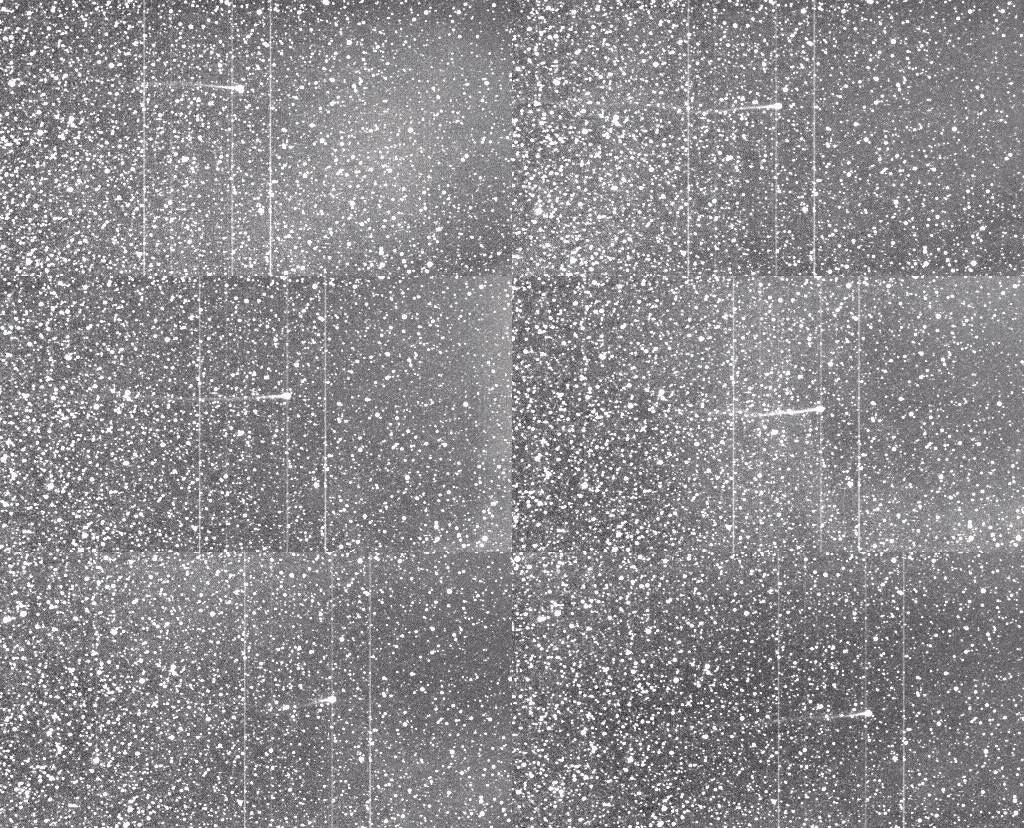
Remarkably, the tail is gonna grow back. They always do. Just like a lizard tail.
Comet Lulin rounded the sun in late January, and is now headed very close to us as it leaves the solar system. It's gonna get brighter and show up in the sky earlier and earlier in the night as it gets closer. Mid to late February it might get bright enough to see with the naked eye, as a fuzzy, indistinct star. You show easily be able to see it with binoculars. You can find out for yourself if the tail grew back or not.
This is gonna be cool.
Wednesday, January 28, 2009
Just Look Up
I was out in the back yard with binoculars last weekend trying - unsuccessfully - to find Comet Kushida (a bigger one, Comet Lulin, is at full brightness next month). But it was a crisp, clear night, and I amused myself by looking at the Orion Nebula (the middle "star" in Orion's sword), the Hyades star cluster (just to the right of Orion, in Taurus's head), the Pleiades cluster (up and to the right of the Hyades, looks like a big fuzzy thing when seen by the naked eye; the seven biggest stars are said to be seven sisters driven mad by moonlight). I got spoiled by my telescope and had forgotten how much you can see with just binoculars. So if you've got some, go out there and have a look around.
If you don't have binoculars, go out there and look around anyway. Orion and the surrounding stars are in full glory now. So here's a primer. These were the first star names I committed to memory upon getting sucked into astronomy, and I continue to have a real fondness for them. These are the brightest stars in the winter sky, often called the Winter G, or the Winter Football, because of the shape.

We'll start with Betelgeuse (pronunced Beetle juice, meaning literally "the armpit of the great one"), Orion's left arm, a very old red giant that I've read is one of the most likely stars to explode into a supernova in our lifetime. Might happen in 100,000 years. Might happen tonight.
Go from Orion's left arm down to the right leg. That's Rigel, a very young bluish star.
Go below and to the left of Orion to a very bright star, Sirius. This is the brightest star in the sky. You can use it as a test to tell if something is a planet or a star: compare it to Sirius. If it's brighter than Sirius, it has to be a planet.
Go above and to the left of Sirius now, to the next bright star. That's Procyon. I love that name: Procyon. It got alotta mentions in The First Novel.
Above Procyon are two stars side by side. They are the twins, Pollux and Castor, in Gemini.
Go over now, above Orion's head. The bright star up there is Capella. Now go down, to the right of Orion. That's Aldebaran, in Taurus, another beautiful name.
So put on a coat and go outside tonight and try to find them all. The names alone are worth memorizing, because they're so fun to say, so pretty to hear, so evocative. But being able to pair the name with the star itself adds a whole new level of meaning.
Plus there's a chance, albeit slight, you'll get to see Betelgeuse blow up!
If you don't have binoculars, go out there and look around anyway. Orion and the surrounding stars are in full glory now. So here's a primer. These were the first star names I committed to memory upon getting sucked into astronomy, and I continue to have a real fondness for them. These are the brightest stars in the winter sky, often called the Winter G, or the Winter Football, because of the shape.

We'll start with Betelgeuse (pronunced Beetle juice, meaning literally "the armpit of the great one"), Orion's left arm, a very old red giant that I've read is one of the most likely stars to explode into a supernova in our lifetime. Might happen in 100,000 years. Might happen tonight.
Go from Orion's left arm down to the right leg. That's Rigel, a very young bluish star.
Go below and to the left of Orion to a very bright star, Sirius. This is the brightest star in the sky. You can use it as a test to tell if something is a planet or a star: compare it to Sirius. If it's brighter than Sirius, it has to be a planet.
Go above and to the left of Sirius now, to the next bright star. That's Procyon. I love that name: Procyon. It got alotta mentions in The First Novel.
Above Procyon are two stars side by side. They are the twins, Pollux and Castor, in Gemini.
Go over now, above Orion's head. The bright star up there is Capella. Now go down, to the right of Orion. That's Aldebaran, in Taurus, another beautiful name.
So put on a coat and go outside tonight and try to find them all. The names alone are worth memorizing, because they're so fun to say, so pretty to hear, so evocative. But being able to pair the name with the star itself adds a whole new level of meaning.
Plus there's a chance, albeit slight, you'll get to see Betelgeuse blow up!
Wednesday, January 14, 2009
Huge Applet, Unsearchable Terrestrials!
Astronomers are a wacky bunch. They often code their discoveries in anagrams, in part to prove they made the discovery while they go through the mind-numbing process of slogging through the data before they can publish.
And, in part, I suspect, because they're just wacky.
Galileo did it when he discovered Venus had phases. Huygens did it when he figured out Saturn had rings. And now Gregory Laughlin of the University of California has done it, by publishing the anagram "Huge Applet, Unsearchable Terrestrials!" to announce he's discovered a planet.
Readers of his website have posted all sorts of possible solutions:
"Transit SuperEarth, Pale Blue Gel."
“Grail result, alp cent bee has super earth!”
“Super Earth At Alpha Cen B. Rigel, Less True.”
“Bells greet Alpha Centauri’s Super Earth!”
“This huge pulsar celebrates rare planet.”
Most of these invoke a planet revolving around the star Alpha Centauri B. I don't have the energy to try to come up with a solution on my own, let alone see if the solutions I've printed use all the letters. I get tired just thinking about it.
Thanks to the excellent Teirneylab blog for all this info, which I've shamelessly stolen.

I freaking love comets. Little bits of rock and ice from back before the Earth was born. The truly spectacular ones only come around about once a decade, but if you've got binoculars and geeky inclinations you can see at least couple a year.
There's a new one out there now: Comet Lulin. Right now it's pretty dim, and you gotta get up just before dawn to see it - two big strikes right there. But by mid-February it'll be in the pre-midnight sky, and visible to the naked eye, albeit barely.
This will be the first one I'll be able to see through the big, dumb, cheap telescope. They look like fuzzy snowballs, and are quite pretty. Plus, this one is apparently going so fast you can detect it's motion against the backdrop of stars over a couple hours.
I'm as giddy as a schoolgirl.
And, in part, I suspect, because they're just wacky.
Galileo did it when he discovered Venus had phases. Huygens did it when he figured out Saturn had rings. And now Gregory Laughlin of the University of California has done it, by publishing the anagram "Huge Applet, Unsearchable Terrestrials!" to announce he's discovered a planet.
Readers of his website have posted all sorts of possible solutions:
"Transit SuperEarth, Pale Blue Gel."
“Grail result, alp cent bee has super earth!”
“Super Earth At Alpha Cen B. Rigel, Less True.”
“Bells greet Alpha Centauri’s Super Earth!”
“This huge pulsar celebrates rare planet.”
Most of these invoke a planet revolving around the star Alpha Centauri B. I don't have the energy to try to come up with a solution on my own, let alone see if the solutions I've printed use all the letters. I get tired just thinking about it.
Thanks to the excellent Teirneylab blog for all this info, which I've shamelessly stolen.

I freaking love comets. Little bits of rock and ice from back before the Earth was born. The truly spectacular ones only come around about once a decade, but if you've got binoculars and geeky inclinations you can see at least couple a year.
There's a new one out there now: Comet Lulin. Right now it's pretty dim, and you gotta get up just before dawn to see it - two big strikes right there. But by mid-February it'll be in the pre-midnight sky, and visible to the naked eye, albeit barely.
This will be the first one I'll be able to see through the big, dumb, cheap telescope. They look like fuzzy snowballs, and are quite pretty. Plus, this one is apparently going so fast you can detect it's motion against the backdrop of stars over a couple hours.
I'm as giddy as a schoolgirl.
Wednesday, January 9, 2008
Not Gonna Happen
During Christmas break it was announced that not only might an asteroid slam into Mars, but it might do so right in front of one of the Mars rovers, giving us all a front row seat. I was excited. So were the kids. So were all the wackos calling up Art Bell that night. The initial odds were set at 1 in 75, but a week or so later they shot up to 1 in 25.
Sadly, they are now setting odds at 1 in 40, and estimate it'll miss by 20,000-ish miles. Bummer.
It reminded me of when this thing slammed into Jupiter back in 94. Now THAT was cool.

It's Comet Shoemaker-Levy 9, the "string of pearls" comet, one that got broken up by Jupiter's gravity in 1992, then utterly demolished a couple years later. On national TV, no less.
Sadly, they are now setting odds at 1 in 40, and estimate it'll miss by 20,000-ish miles. Bummer.
It reminded me of when this thing slammed into Jupiter back in 94. Now THAT was cool.

It's Comet Shoemaker-Levy 9, the "string of pearls" comet, one that got broken up by Jupiter's gravity in 1992, then utterly demolished a couple years later. On national TV, no less.
Saturday, January 5, 2008
Christmas comet
 I promise this blog won't always be about comets. Here at The Cloud we have many interests.
But there's a new comet out there (8p/Tuttle), just below naked eye visablility, that I hope to get out and see as soon as this damn cold subsides. And I saw this beauty - Comet Holmes - over several nights in late October/early December. It brightened a million fold in just over an hour in October 07, and was easily visible to the naked eye as a fuzzy patch just below and to the right of Cassiopeia. With binocs you could make out a little of the structure. Very pretty.
It's still around now, bigger and dimmer and in pretty much the same place, since it's heading more or less straight away from the earth.
I took the family out to see this one, because it was so bright. The girls said they saw it, but they could have been looking at anything: a star, an airplane, a squirrel, the TV antenna. They're pretty young.
L-Hux and I have been good about teaching them the night sky. I show them the planets when they're out, and they are pretty good at finding them on their own. Though they think everything is Jupiter. And L-hux has begun the delightful tradition of driving us all out to a bluff over the Arkansas river a couple blocks from our house to watch the full moon rise. Not every month, but most. We sit in the car and let the girls play in the front seat (otherwise verboten territory) and see who can spot it first. Fun. Don't now if we are making little amateur astronomers of them or not, but hopefully we are making some memories.
Subscribe to:
Posts (Atom)